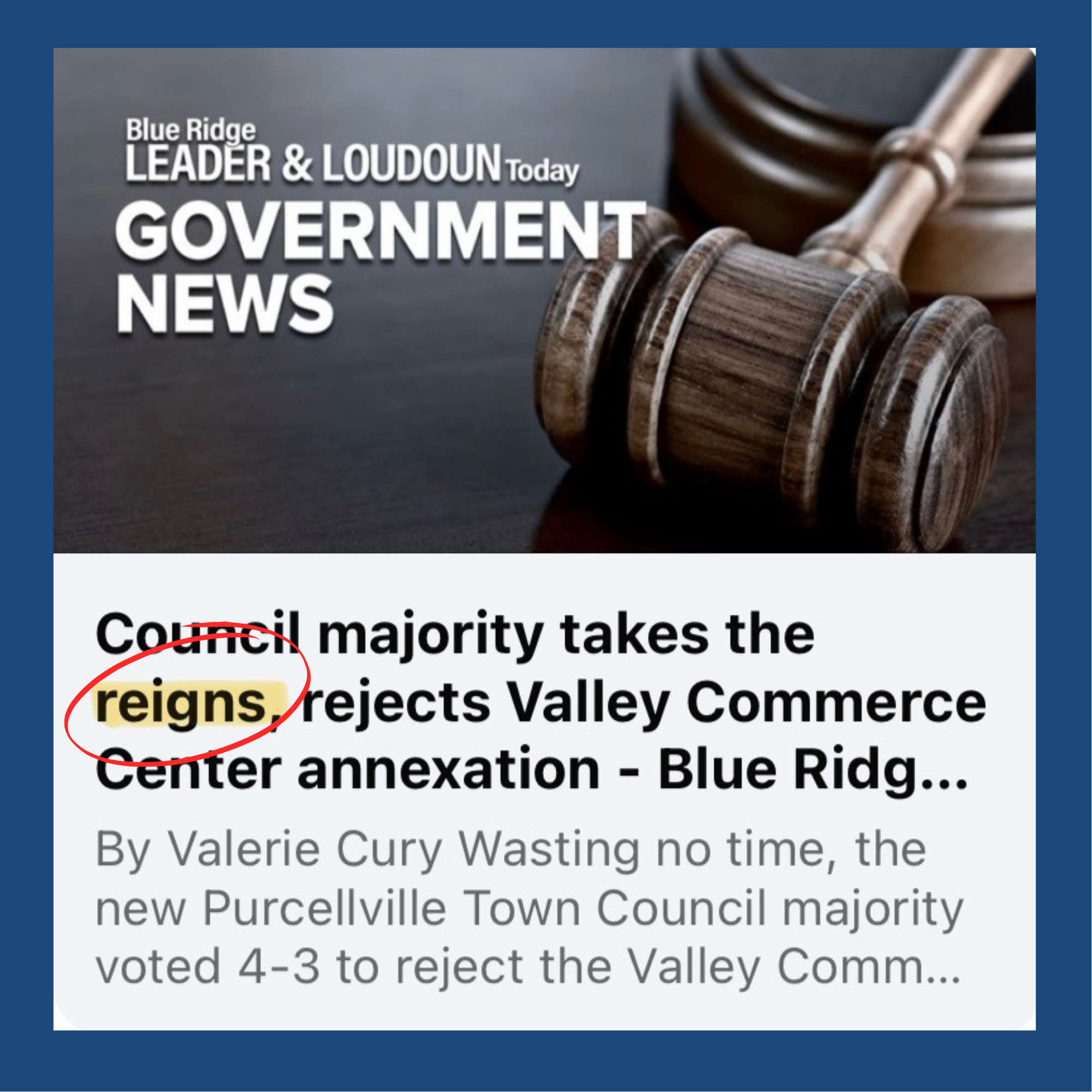
In a recent article titled “Council Majority Takes the Reigns, Rejects Valley Commerce Center Annexation,” the Blue Ridge Leader’s Valerie Cury made a curious choice in language that has not gone unnoticed. The term “reigns,” typically associated with monarchs who wield power as king or queen, was utilized instead of the more conventional “reins,” which would imply control or guidance in the context of leadership.
The decision to reject the Valley Commerce Center annexation, which held the promise of economic growth and job creation for the community, has drawn significant scrutiny. Critics argue that the council’s actions reflect a growing disconnect between elected officials and the constituents they serve. In this light, the use of “reigns” seems particularly fitting, as it evokes imagery of a governing body that exercises control in a manner reminiscent of a dictatorship. By focusing on personal agendas rather than the broader interests of the community, the council majority appears to be prioritizing their own authority over democratic engagement.
This linguistic choice raises intriguing questions about the implications of governance in Purcellville. If Cury’s use of “reigns” was a slip of the pen, it highlights a subconscious recognition of the current council’s approach to leadership.
In essence, the choice of words in the Blue Ridge Leader’s article serves as a powerful commentary on the current state of governance in Purcellville. Whether a mistake or a deliberate choice, the use of “reigns” invites readers to reflect on the nature of leadership and accountability within their town council. As the community continues to gabble with the implications of the Valley Commerce annexation, one thing remains clear: the dialogue surrounding governance, transparency, and citizen engagement is more important than ever.