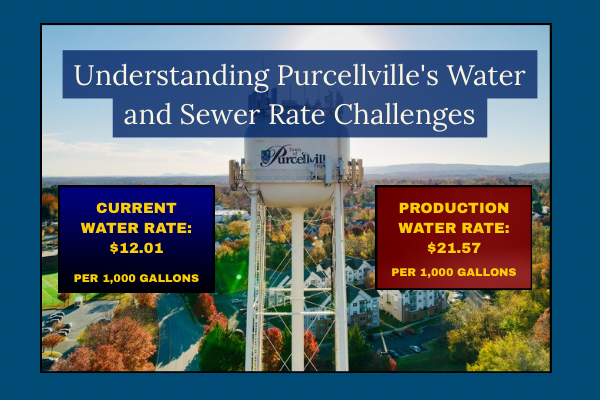
During the Purcellville Town Council meeting on March 24th, Stantec presented the Fiscal Year (FY) 2027 Utility Rate Modeling, reflecting a stark reality regarding the town’s water and sewer rates. For the past two decades, Purcellville has contracted Stantec to conduct rate modeling based on projected revenues and expenses.
Proposed Rate Increases
Stantec provided three options for potential utility rate increases for FY 27, each pertaining to the Water and Wastewater funds:
– Water Rate Increases: 24%, 30%, or 40%
– Wastewater Rate Increases: 16%, 22%, or 26.5%
Stantec explained that the water and sewer funds function like a business, meaning revenue must cover operating costs. The rate projections consider operating costs, capital project expenses, debt service, and the aim of achieving a 100% reserve balance to maintain a strong credit rating. This reserve is crucial for addressing emergency situations, such as water line breaks.
Upcoming Changes and Capital Costs
For FY 27, the meals tax will continue to supplement utility expenses but is set to be phased out after this year. This temporary measure was implemented last year to allow for a reduction in utility rates. However, Stantec has historically advised against mixing general funds with enterprise funds, cautioning that it could negatively impact future credit ratings.
A significant portion of the FY 27 utility budget will be allocated to capital projects necessary for ensuring safe drinking water and a wastewater treatment plant that complies with state regulations. The water department has projected $22 million in capital project requirements, while the wastewater plant will need $6.3 million.
Cost of Water Production
A key point in Stantec’s presentation highlighted a disparity in Purcellville’s current rate structure. The town charges an average homeowner $12.01 per 1,000 gallons of water, while the cost to produce that same amount is $21.57. Additionally, municipalities, including Purcellville, are experiencing a 1% decline in water usage per unit, leading to reduced homeowner utility expenses and consequently decreased revenue for the town.
Stantec also provided insights into neighboring towns facing similar utility rate challenges. Many residents in Round Hill and Hamilton pay a surcharge because they live outside incorporated limits. Loudoun County has recently stepped in to assist Round Hill by providing funding for a new water tower needed for non-town residents.
Over the past decade, Stantec and town staff have recommended gradual increases in utility rates to avoid the significant hikes currently faced by Purcellville. In 2020, with interest rates at historic lows, Stantec advised that it was a favorable time to secure bonds for capital projects instead of relying on reserve funds.
Despite these recommendations, Purcellville’s mayors have historically campaigned for no or modest rate increases, often disregarding warnings about the long-term financial implications. The utility reserve balance that had been available to support operating costs and capital projects has diminished, particularly after changes in town management that aimed to incorporate new ideas.
In 2021, Purcellville received $10.5 million in American Rescue Plan Act (ARPA) funds to mitigate COVID-19 impacts, which were utilized for reservoir projects, a new water tank, and police headquarters renovations.
Conclusion
The Stantec presentation underscored significant financial realities facing Purcellville, revealing a consensus among council members about the challenges ahead in managing utility rates.